
This post contains affiliate links. As an Amazon Associate I earn from qualifying purchases.
Learning to make bacon wrapped smokies isn’t just about creating one beloved appetizer—it’s about mastering a foundational cooking technique that unlocks dozens of other recipes. When you understand how to wrap, secure, and bake proteins with flavorful coverings, you’ll find yourself confidently preparing everything from BBQ ribs to slow cooker creations to more elaborate meat preparations. This simple dish teaches you precision, timing, and how to coax deep, caramelized flavors from humble ingredients.
Master the Technique Behind Bacon Wrapped Smokies Recipe (And Never Struggle in the Kitchen Again)
I remember the first time my mother wrapped little smokies in bacon for a church potluck. I was maybe twelve years old, watching from my step stool in her kitchen as she worked with such careful intention. She didn’t rush. She cut the bacon into exact pieces, wrapped each smokie like she was tucking a child into bed, and secured it with a toothpick.
“Glennis,” she said, “this isn’t fancy cooking. But it teaches you something important—how to hold flavors together.” When those smokies came out of the oven, the kitchen smelled like caramelized meat and toasted sugar. I watched people at that potluck reach for them over and over. That’s when I understood: mastering the simple techniques creates the most memorable meals.
That lesson stayed with me through nutrition school and into my practice. The wrapping technique you’ll learn here—securing a protein with a flavorful outer layer, then roasting it until both elements caramelize together—is something you’ll use forever.
The Core Technique Explained
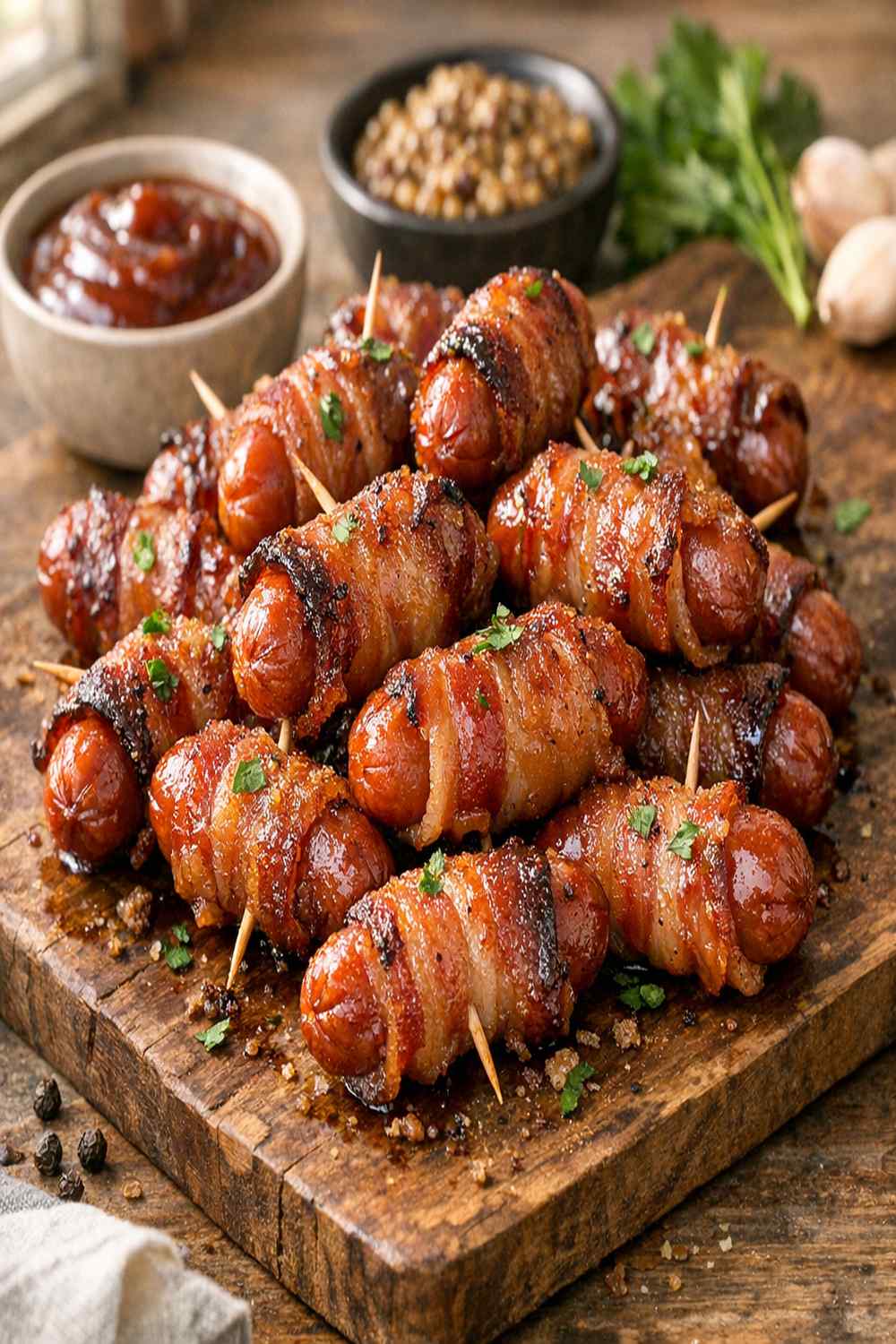
The fundamental cooking technique at work here is called combination roasting with enclosure. It’s simpler than it sounds. You’re taking a lean, mild-flavored protein (the smokies), wrapping it with a fat-rich, flavorful ingredient (the bacon), and then dry-roasting both together in an oven until their flavors marry and their surfaces caramelize.
Here’s the science: when bacon cooks, it renders its fat and creates savory, smoky compounds through something called the Maillard reaction. Those compounds aren’t just flavorful—they’re also adhesive in a culinary sense. The rendered fat bastes the smokie while the outer edges of the bacon brown and crisp. The brown sugar adds another layer of chemistry, developing sweet, complex flavors as it caramelizes at high heat.
The toothpick isn’t just practical—it’s essential to the technique. It holds the bacon in position while both the bacon and smokie shrink slightly during cooking. Without it, you’d have bacon slipping off and smokies rolling around the pan. With it, you get even cooking and that signature neat presentation.
What This Technique Unlocks
Once you master wrapping, securing, and roasting proteins with flavorful coverings, you’ll have the confidence to create dozens of dishes. This is a gateway technique that builds your overall cooking intuition.
- Bacon-wrapped chicken thighs – uses the same wrapping and roasting principle, just with a larger protein that needs slightly longer cooking time
- Prosciutto-wrapped dates – teaches you how to wrap delicate items without overcooking the wrapper
- Sage-wrapped scallops – demonstrates how to wrap without toothpicks using overlapping leaves as natural fasteners
- Herb-crusted roasted vegetables – applies the same dry-roasting technique to create caramelized, crunchy exteriors
- Beef-wrapped cheese bites – shows you how to wrap items that release liquid during cooking
- Bacon-wrapped asparagus bundles – teaches wrapping multiple items together for elegant presentations
The Ingredients – Chosen to Teach the Technique
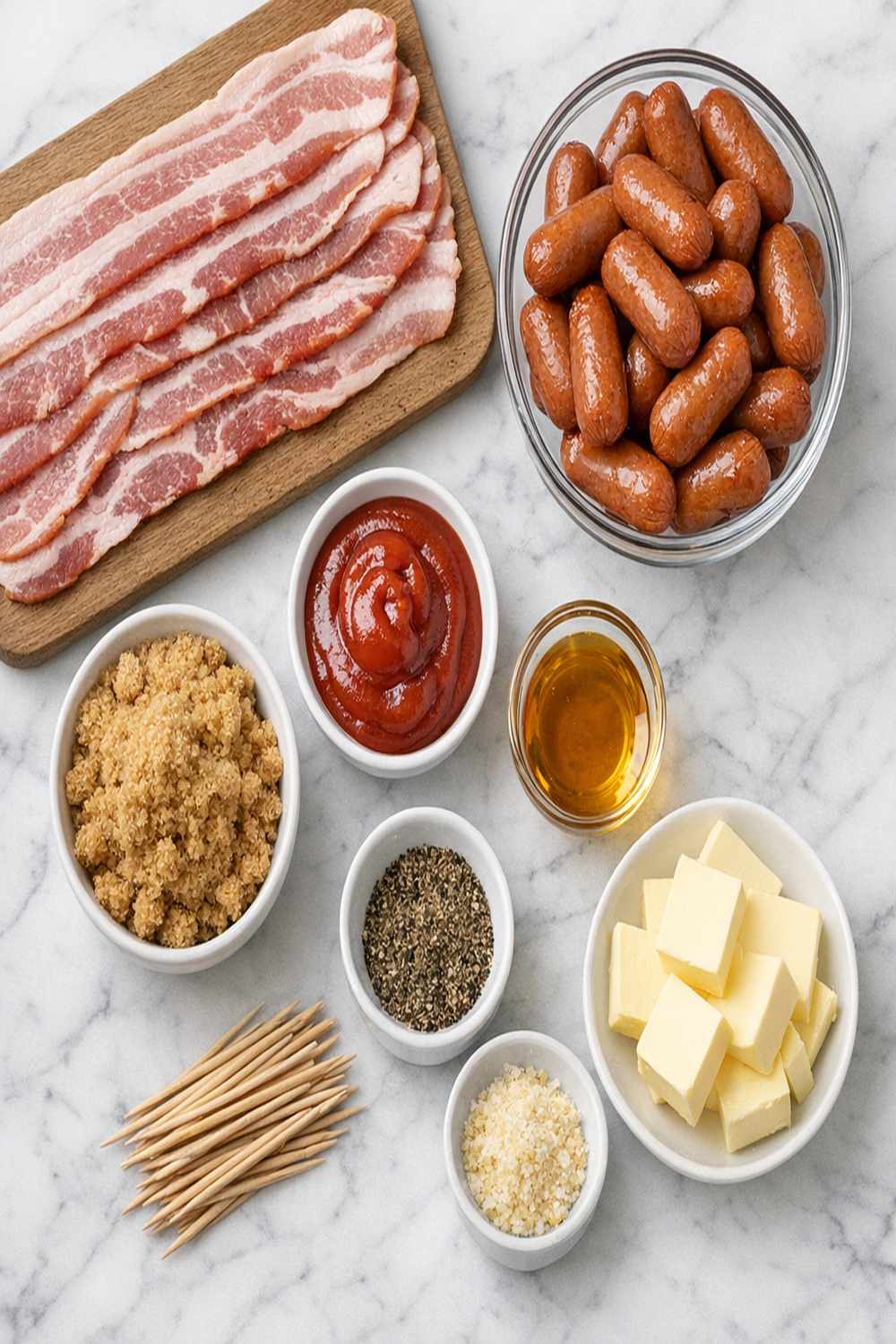
Each ingredient in this recipe was selected specifically to demonstrate the wrapping and roasting technique clearly. The smokies provide a neutral canvas—mild enough that you can see exactly what the bacon and brown sugar are contributing to the flavor profile. The bacon is the star teacher, showing you how fat renders and how edges crisp. The brown sugar demonstrates how sweetness caramelizes under dry heat, creating complex flavors that balance the savory bacon.
- ¼ teaspoon chili powder (optional, but teaches you how small spice additions layer flavor without overwhelming the dish)
- 40 round wooden toothpicks, soaked in water for 15 minutes (water-soaking prevents them from burning and teaches you about ingredient preparation details that matter)
- ½ cup packed brown sugar (the moisture content in packed brown sugar helps it adhere and caramelize evenly)
- 1 teaspoon freshly cracked black pepper (freshly cracked pepper releases oils that intensify flavor more than pre-ground)
- 1 pound cocktail smokies or small link sausages, about 40 pieces total (these mild, uniform pieces give you the perfect canvas for learning wrapping technique)
- 1 pound regular-cut bacon, approximately 15 to 16 slices (not thick-cut, which won’t wrap properly around the smokies)
The Masterclass: How to Make Bacon Wrapped Smokies Recipe
This is where you move from understanding the technique to living it. I’m going to walk you through each step, explaining not just what to do, but why each action matters. This is how real learning happens in the kitchen.
Step 1: Prepare Your Oven and Pan with Intention
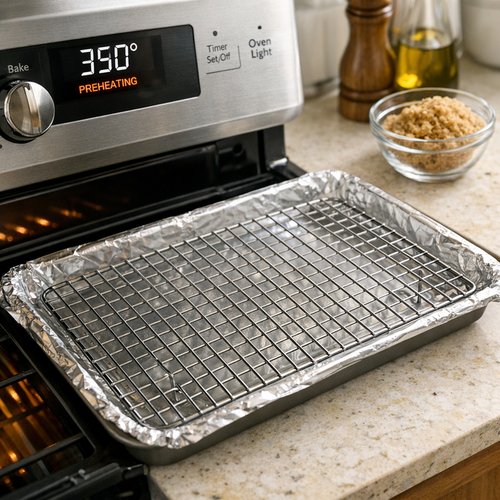
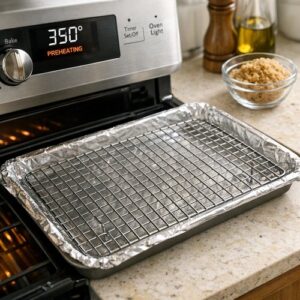
Start by preheating your oven to 350 degrees Fahrenheit. This temperature is specific—it’s hot enough to render the bacon fat and develop caramelization, but not so hot that it burns the brown sugar before the bacon crisps. Give your oven at least 15 minutes to reach full temperature. An oven thermometer is worth its weight in gold here. Trust me on this.
While your oven heats, line a standard 10-by-15-inch sheet pan with parchment paper or aluminum foil. This step teaches you something I use in my nutrition practice constantly: setting up your workspace before you need it eliminates stress. You won’t be fumbling for paper when your hands are full of wrapped smokies.
Step 2: Soak Your Toothpicks (The Detail That Separates Good From Great)
Place 40 wooden toothpicks in a shallow bowl of water. Let them soak for at least 15 minutes. This is the kind of detail that separates casual cooks from intentional ones. Soaked toothpicks won’t ignite in your hot oven, and they won’t impart a burnt flavor to your finished dish. This tiny step teaches you that cooking mastery lives in the details.
Step 3: Prepare Your Bacon With Precision Cuts
Remove your bacon from its package. Now comes the cutting technique that’s crucial to this recipe. You’re aiming for pieces that are 3 to 4 inches long—not smaller, not larger. Here’s why: bacon shrinks as it cooks, both in length and width. A 3-to-4-inch piece will wrap around your smokie just slightly more than once, creating overlapping bacon that crisps beautifully without leaving gaps.
Use a sharp chef’s knife and cut with confidence in one smooth motion for each cut. Don’t saw back and forth—that damages the bacon’s structure. One clean cut teaches your knife skills while honoring the ingredient. If you find yourself with extra bacon after wrapping all your smokies, that’s perfect. Pop it in the freezer for future use. Waste nothing.

Step 4: Master the Wrapping Technique
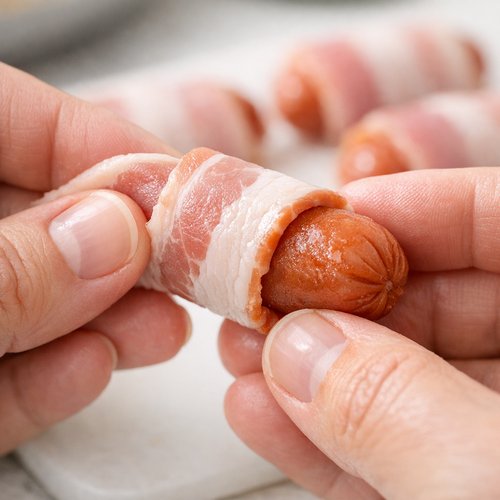
Now we get to the heart of the technique. Pick up one piece of bacon and one smokie. Wrap the bacon around the smokie in one smooth motion, overlapping the ends slightly. The overlap is important—it prevents the bacon from unraveling during cooking.
Immediately secure it with one of your soaked toothpicks, piercing through the overlapped bacon edge and slightly into the smokie. The toothpick should go straight through—not at an angle, not too deep. Straight through teaches your hand precision and consistency. Every smokie wrapped the same way cooks the same way.
Place the wrapped smokie, seam-side up, on your prepared pan. The seam-side up positioning is intentional—it allows you to see whether the bacon is cooking evenly and crisping properly. Repeat this wrapping motion with all remaining smokies and bacon pieces. You’re teaching your hands muscle memory with every single one.
Step 5: Apply Your Flavor Layer With Even Distribution
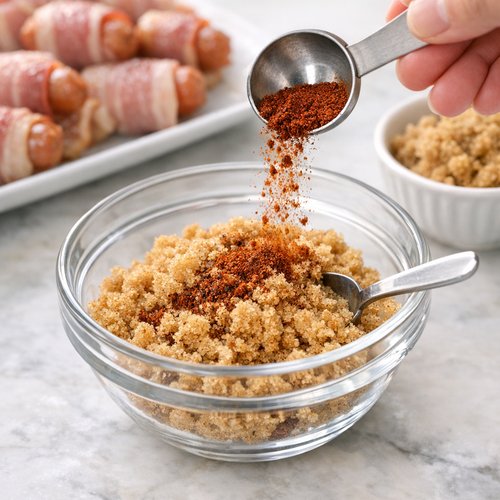
In a small bowl, combine your ½ cup of packed brown sugar with the ¼ teaspoon of chili powder, if using. The chili powder is optional, but it teaches you an important lesson: how to layer savory notes alongside sweet ones. Skip it if you prefer pure smoky-sweet. Add the cracked black pepper.
Sprinkle this mixture evenly over all the wrapped smokies. This even distribution is crucial. If one smokie gets more sugar than another, it will brown faster and potentially burn while others are still developing color. Use your fingertips to sprinkle gently, making sure every single wrapped smokie gets its share. This teaches you portion control and visual consistency.
Step 6: Roast With Confidence and Patience
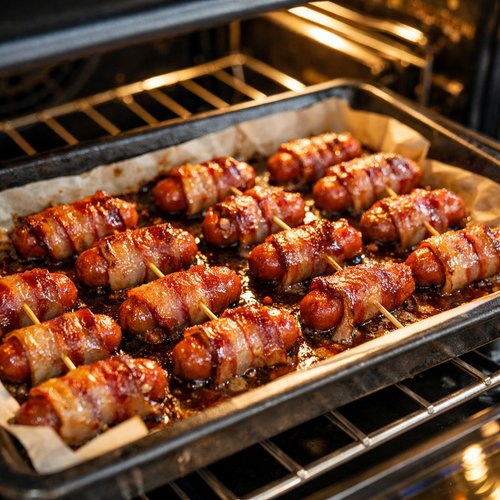
Place your pan in the preheated 350-degree oven. Roast for 35 to 45 minutes. The time varies slightly based on how evenly your oven heats and how tightly you wrapped each piece. You’re not looking for a timer—you’re looking for visual doneness.
At the 30-minute mark, open your oven and take a look. You should see the bacon beginning to brown and the brown sugar starting to caramelize around the edges. The bacon should not be fully crisp yet—that’s coming. If your bacon edges are already very dark brown, you’re close. If they’re still pale, you have more time ahead.
Step 7: Recognize Perfect Doneness and Cool Properly
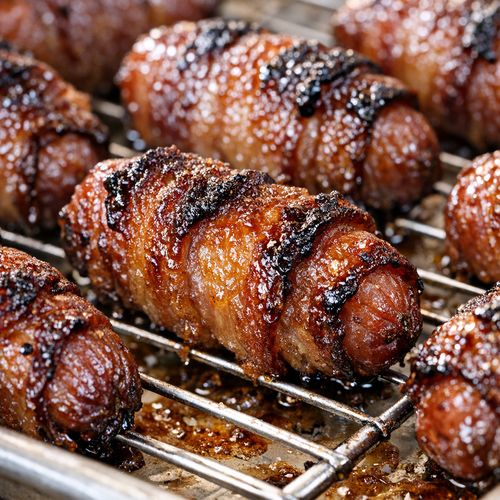
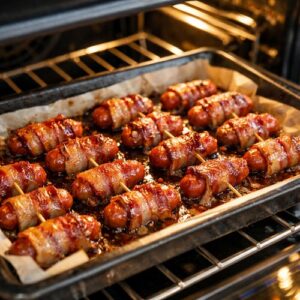
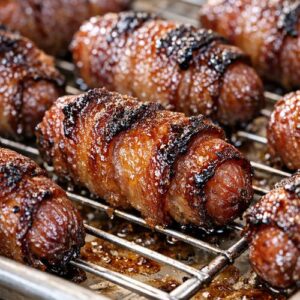
Perfect doneness looks like this: the bacon is crispy and deeply browned, with some darker caramelized edges. The brown sugar has melted and turned into a glossy caramel coating that may have some slightly darker spots. The bacon should be crispy enough that a piece breaks cleanly between your fingers, not bend and fold.
Remove the pan from the oven and set it on a heat-safe surface. This is crucial: let the smokies cool for at least 10 minutes before serving. During this resting period, residual heat continues cooking the interior while the exterior sets up. The caramel also hardens slightly, making the whole piece more structurally sound.
Resist the urge to rush. I know they smell incredible and you want to eat them immediately. But that 10-minute rest teaches you patience—something every great cook needs. It also prevents burnt mouths, which is practical wisdom.
How to Know You’ve Mastered the Technique
True mastery isn’t just about following steps—it’s about recognizing when something is truly done. Here’s what perfection looks like, sounds like, and feels like:
- Visual doneness – the bacon is mahogany brown with crispy, slightly curled edges; the brown sugar coating has darkened and caramelized; there are no pale, undercooked bacon sections visible
- Textural doneness – when you pick up a cooled smokie, the bacon breaks cleanly and crisps audibly between your teeth; it’s not chewy or soft, but genuinely crispy
- Aroma doneness – your kitchen smells like caramelized meat and toasted sugar, with no burnt or acrid notes; if something smells burnt, you’ve gone too far
- Consistency mastery – every single smokie on the pan looks nearly identical in terms of browning and bacon crispness; this shows you’ve distributed ingredients evenly and maintained consistent wrapping
Common Technique Mistakes and How to Fix Them
- Bacon slipping off during cooking – this happens when your toothpick placement is inconsistent or your wrapping is too loose. Solution: wrap tighter, ensuring overlap of at least ½ inch, and drive your toothpick straight through both layers of bacon
- Brown sugar burning while bacon stays soft – your oven temperature is too high or you’re cooking too long. Solution: verify your oven temperature with a thermometer; 350 degrees is the sweet spot. If browning too fast, reduce to 325 degrees
- Uneven browning across the pan – your oven has hot spots, or you didn’t distribute the brown sugar evenly. Solution: rotate your pan 180 degrees at the 20-minute mark; this balances exposure to heat
- Toothpicks burning or coming loose – you skipped soaking them or they’re too thin. Solution: always soak for 15 minutes; use standard round toothpicks, not fancy flat ones that don’t hold as well
- Smokies bursting or leaking liquid – this usually means your heat is too high or you’re cooking too long. Solution: stick to 350 degrees; these little proteins don’t need more than 45 minutes maximum
Practice Variations to Build Your Skill
Now that you understand the foundational technique, it’s time to practice with progressively challenging variations. Each builds your skills in different ways.
Variation 1: The Classic (Your Foundation Work) – Make the recipe exactly as written. This is your baseline. Make it three times, and by the third batch, your wrapping should be faster and more consistent. You’re building muscle memory. Don’t skip this step just because it seems simple.
Variation 2: The Herbaceous Twist (Learning Flavor Layering) – Keep everything the same, but add 1 tablespoon of fresh rosemary leaves (finely chopped) and 1 teaspoon of smoked paprika to your brown sugar mixture. This teaches you how to layer savory spices with sweet caramelization. The herbs should smell fragrant but not burnt. If they smell acrid, you overcooked them.
Variation 3: The Gourmet Challenge (Mastering Precision Under Complexity) – Wrap your smokies, but instead of brown sugar alone, create a glaze by mixing ¼ cup brown sugar, 2 tablespoons Dijon mustard, 1 tablespoon apple cider vinegar, and ½ teaspoon garlic powder. Brush this glaze onto each wrapped smokie before baking. This teaches you how to handle wet ingredients during roasting—the glaze will darken and stick to the bacon, creating complex sweet-savory-tangy flavors. This variation requires you to work more carefully and understand how moisture affects caramelization.
Can I Store Bacon Wrapped Smokies Recipe?
Yes, and this is where the technique teaches you beyond the cooking itself. Baked smokies keep refrigerated for up to 4 days in an airtight container. The bacon will soften slightly as moisture from the smokies releases, but it still tastes wonderful.
To reheat, place them on a sheet pan in a 325-degree oven for about 8 minutes. This gentle reheating restores some crispness without overcooking. Do not microwave—this will make the bacon rubbery. If you’re serving at a party, reheat just before guests arrive.
You can also freeze baked smokies for up to 3 months. Cool them completely first, then layer them in a freezer-safe container with parchment paper between layers. Reheat from frozen at 325 degrees for about 12 minutes. This make-ahead capability is one reason this recipe has fed gatherings for generations.
If you want to assemble but not bake ahead of time, you can wrap and refrigerate unbaked smokies for up to 24 hours. Just add 5 to 10 minutes to your baking time since they’ll be cold when they enter the oven.
Expert’s Nutritional Insight
As a registered dietitian, I want to share something important about this recipe: smokies are processed meat, which means they contain sodium and preservatives. But here’s what makes this preparation valuable from a nutrition standpoint—you’re eating them intentionally, in measured portions, as part of a gathering or meal. This is what balanced eating looks like in real life.
One wrapped smokie provides approximately 120 calories, 9 grams of fat, 6 grams of protein, and about 280 milligrams of sodium. The brown sugar adds about 15 calories and 4 grams of carbohydrates per smokie. These are protein-fat combinations that provide satiety—meaning they help you feel satisfied, so you’re less likely to overeat.
I recommend serving these as part of a meal with vegetable sides rather than as unlimited appetizers. Pair them with fresh buns and vegetable-forward sides, and you’ve created balance. The vegetables add fiber that moderates how quickly the sugars and fats hit your bloodstream.
Make-Ahead Guide for Stress-Free Entertaining
Here’s how I help my clients prepare for gatherings without kitchen chaos:
Three Days Before: Buy your bacon and smokies. Store bacon in its original packaging. Store smokies in their container. Both keep perfectly fine until the day before.
One Day Before: Soak your toothpicks (or do this the morning of). Cut your bacon into 3-to-4-inch pieces. Store pieces in a sealed container in the refrigerator—they won’t stick together if you layer them with parchment paper between groups. Wrap your smokies. Place them on a baking sheet, cover with plastic wrap, and refrigerate.
One Hour Before Serving: Preheat your oven. Let wrapped smokies come to room temperature for about 10 minutes while the oven heats. Mix your brown sugar with chili powder and pepper. Sprinkle over smokies. Bake for 40 to 45 minutes (add 5 minutes since they’re coming from the fridge). Let cool. Serve.
The Actual Event: You’ll be relaxed. Everything is ready. You’re present with your guests instead of stressed in the kitchen. This is the real gift of understanding technique—it frees you emotionally.
Seasonal Variations: Adapting the Recipe Year-Round
Spring Version: Replace ½ of the brown sugar with honey. Add 1 teaspoon of fresh thyme leaves to the mixture. Thyme and honey together taste like spring gatherings. The honey caramelizes slightly differently than brown sugar, creating a more delicate sweetness.
Summer Version: Add ½ teaspoon of dry mustard and ¼ teaspoon of cayenne pepper to the brown sugar mixture. These spices echo summer barbecues. Some people like to brush the baked smokies with a bit of barbecue sauce during the last 5 minutes of cooking.
Fall Version: Replace the chili powder with pumpkin pie spice. Add 1 tablespoon of maple syrup mixed into the brown sugar coating. This creates warm, complex autumn flavors that pair beautifully with fall gatherings.
Winter Version: Add ½ teaspoon of ground ginger and 1 teaspoon of fresh orange zest to the brown sugar mixture. These flavors feel festive and warm without being heavy.
Nutrition Information
According to USDA nutritional data, one bacon-wrapped smokie (approximately 30 grams) provides:
- Calories: 120
- Protein: 6 grams (supports muscle maintenance and satiety)
- Fat: 9 grams (mostly from bacon, provides fat-soluble vitamin absorption)
- Carbohydrates: 4 grams (from brown sugar caramelization)
- Sodium: 280 milligrams (from cured meat; about 12% of daily recommended intake)
- Fiber: 0 grams (reason to serve with vegetable sides)
These appetizers are best enjoyed as part of a balanced meal, not as unlimited snacking. When you pair them with fresh vegetables, whole-grain sides, or a green salad, you create nutritional balance that feels festive and satisfying.
What to Serve With Bacon Wrapped Smokies Recipe?
These little bites deserve accompaniments that let their caramelized, savory-sweet flavor shine while providing nutritional balance:
- Roasted vegetable medley – zucchini, bell peppers, and cherry tomatoes tossed with olive oil and herbs, roasted at the same temperature as your smokies. They finish together, and the vegetables’ natural sweetness complements the bacon caramel
- Simple green salad – crisp greens with a light vinaigrette cuts through the richness beautifully, cleansing your palate between bites
- Soft dinner rolls – warm, fresh buns invite guests to create little sandwiches, turning appetizers into more substantial bites
- Mustard and pickle station – whole grain mustard and crispy pickles provide acidic, bright flavors that balance the smokies’ richness
- Cornbread or corn salad – corn’s natural sweetness echoes the brown sugar caramelization while adding texture and substance
- Herb-roasted potatoes – little cubes of potato, roasted with rosemary and garlic, create a complete appetizer board that feels abundant

Bacon Wrapped Smokies Recipe
Ingredients
- ¼ teaspoon chili powder optional, but teaches you how small spice additions layer flavor without overwhelming the dish
- 40 round wooden toothpicks, soaked in water for 15 minutes water-soaking prevents them from burning and teaches you about ingredient preparation details that matter
- ½ cup packed brown sugar the moisture content in packed brown sugar helps it adhere and caramelize evenly
- 1 teaspoon freshly cracked black pepper freshly cracked pepper releases oils that intensify flavor more than pre-ground
- 1 pound cocktail smokies or small link sausages, about 40 pieces total these mild, uniform pieces give you the perfect canvas for learning wrapping technique
- 1 pound regular-cut bacon, approximately 15 to 16 slices not thick-cut, which won't wrap properly around the smokies
Instructions
Step 1: Prepare Your Oven and Pan with Intention
- Start by preheating your oven to 350 degrees Fahrenheit. This temperature is specific—it's hot enough to render the bacon fat and develop caramelization, but not so hot that it burns the brown sugar before the bacon crisps. Give your oven at least 15 minutes to reach full temperature. An oven thermometer is worth its weight in gold here. Trust me on this. While your oven heats, line a standard 10-by-15-inch sheet pan with parchment paper or aluminum foil. This step teaches you something I use in my nutrition practice constantly: setting up your workspace before you need it eliminates stress. You won't be fumbling for paper when your hands are full of wrapped smokies.
Step 2: Soak Your Toothpicks (The Detail That Separates Good From Great)
- Place 40 wooden toothpicks in a shallow bowl of water. Let them soak for at least 15 minutes. This is the kind of detail that separates casual cooks from intentional ones. Soaked toothpicks won't ignite in your hot oven, and they won't impart a burnt flavor to your finished dish. This tiny step teaches you that cooking mastery lives in the details.
Step 3: Prepare Your Bacon With Precision Cuts
- Remove your bacon from its package. Now comes the cutting technique that's crucial to this recipe. You're aiming for pieces that are 3 to 4 inches long—not smaller, not larger. Here's why: bacon shrinks as it cooks, both in length and width. A 3-to-4-inch piece will wrap around your smokie just slightly more than once, creating overlapping bacon that crisps beautifully without leaving gaps. Use a sharp chef's knife and cut with confidence in one smooth motion for each cut. Don't saw back and forth—that damages the bacon's structure. One clean cut teaches your knife skills while honoring the ingredient. If you find yourself with extra bacon after wrapping all your smokies, that's perfect. Pop it in the freezer for future use. Waste nothing.

Step 4: Master the Wrapping Technique
- Now we get to the heart of the technique. Pick up one piece of bacon and one smokie. Wrap the bacon around the smokie in one smooth motion, overlapping the ends slightly. The overlap is important—it prevents the bacon from unraveling during cooking. Immediately secure it with one of your soaked toothpicks, piercing through the overlapped bacon edge and slightly into the smokie. The toothpick should go straight through—not at an angle, not too deep. Straight through teaches your hand precision and consistency. Every smokie wrapped the same way cooks the same way. Place the wrapped smokie, seam-side up, on your prepared pan. The seam-side up positioning is intentional—it allows you to see whether the bacon is cooking evenly and crisping properly. Repeat this wrapping motion with all remaining smokies and bacon pieces. You're teaching your hands muscle memory with every single one.

Step 5: Apply Your Flavor Layer With Even Distribution
- In a small bowl, combine your ½ cup of packed brown sugar with the ¼ teaspoon of chili powder, if using. The chili powder is optional, but it teaches you an important lesson: how to layer savory notes alongside sweet ones. Skip it if you prefer pure smoky-sweet. Add the cracked black pepper. Sprinkle this mixture evenly over all the wrapped smokies. This even distribution is crucial. If one smokie gets more sugar than another, it will brown faster and potentially burn while others are still developing color. Use your fingertips to sprinkle gently, making sure every single wrapped smokie gets its share. This teaches you portion control and visual consistency.

Step 6: Roast With Confidence and Patience
- Place your pan in the preheated 350-degree oven. Roast for 35 to 45 minutes. The time varies slightly based on how evenly your oven heats and how tightly you wrapped each piece. You're not looking for a timer—you're looking for visual doneness. At the 30-minute mark, open your oven and take a look. You should see the bacon beginning to brown and the brown sugar starting to caramelize around the edges. The bacon should not be fully crisp yet—that's coming. If your bacon edges are already very dark brown, you're close. If they're still pale, you have more time ahead.
Step 7: Recognize Perfect Doneness and Cool Properly
- Perfect doneness looks like this: the bacon is crispy and deeply browned, with some darker caramelized edges. The brown sugar has melted and turned into a glossy caramel coating that may have some slightly darker spots. The bacon should be crispy enough that a piece breaks cleanly between your fingers, not bend and fold. Remove the pan from the oven and set it on a heat-safe surface. This is crucial: let the smokies cool for at least 10 minutes before serving. During this resting period, residual heat continues cooking the interior while the exterior sets up. The caramel also hardens slightly, making the whole piece more structurally sound. Resist the urge to rush. I know they smell incredible and you want to eat them immediately. But that 10-minute rest teaches you patience—something every great cook needs. It also prevents burnt mouths, which is practical wisdom.
FAQs
Can I make these without toothpicks?
Technically yes, but you’ll struggle. Without toothpicks, the bacon unwraps during cooking, and you lose the technique’s core teaching. If you must skip toothpicks, use wooden skewers cut in half instead. The principle is the same—you’re holding the bacon in place while both ingredients cook and shrink together. But honestly, toothpicks are cheap and perfect for this job. Invest in them.
My bacon wrapped smokies are burning on the outside while the bacon stays soft inside. What’s happening?
Your oven temperature is likely hotter than 350 degrees. Verify with an oven thermometer—many home ovens run hot. If your temperature is correct, you might be using bacon that’s too thin or has been cured with extra sugar. Try a different bacon brand. Also, check that you’re not putting the smokies too close together on the pan. They need air circulation to cook evenly.
How do I wrap smokies uniformly so they all cook at the same rate?
Cut your bacon into consistent pieces first—3 to 4 inches every single time. Wrap each smokie the same way: overlap the ends by ½ inch, secure with the toothpick in the same position on every piece. Arrange them on the pan with equal spacing. When every piece is wrapped identically and spaced identically, cooking time is identical. Precision in setup creates consistency in results.
Can I use thick-cut bacon instead of regular bacon?
I wouldn’t recommend it. Thick-cut bacon is wider, so even at 3-to-4 inches long, it will wrap less than once around a smokie. This creates gaps where the smokie is exposed and can dry out. Thick-cut bacon also takes longer to render its fat, so your total cooking time extends significantly. Stick with regular-cut bacon. It’s designed perfectly for this technique.
What’s the difference between cocktail wieners and smokies?
Often nothing—the terms are used interchangeably. Both refer to small, pre-cooked sausages, usually about 2 inches long. Some regional variations exist: smokies might be slightly spicier in certain areas, while cocktail wieners are sometimes more mild. For this recipe, either works perfectly. Choose whichever your grocery store stocks.
Nutrition and Food Safety Considerations
Smokies are pre-cooked, so you’re not cooking them through—you’re heating them and crisping their exterior coating (the bacon). The internal temperature doesn’t need to reach 165 degrees because the product is already food-safe. Your goal is crispy bacon and caramelized sugar, not a specific internal temperature.
That said, always buy smokies from reputable sources with clear expiration dates. Store them properly before cooking. Once wrapped, refrigerated smokies keep safely for 24 hours. Once cooked, they keep refrigerated for 4 days and frozen for 3 months.
More Recipes Using This Technique
- BBQ Ribs Recipe For Slow Cooker – uses slow, dry-heat cooking to render fat and caramelize surfaces, similar to the technique here but with extended time
- Bacon Wrapped Wieners Recipe – a slight variation on this same technique using different-sized proteins
- BBQ Ham Recipe – applies caramelization and glazing techniques similar to the brown sugar coating used here
- this cozy soup – teaches you how to build rich, bacon-forward flavors through slow cooking
Conclusion: Your New Kitchen Superpower
You’ve now mastered something that has created countless happy gatherings, delighted hundreds of guests, and brought comfort to tables across generations. This isn’t just about making bacon-wrapped smokies—though they’ll be delicious. It’s about understanding that precision, patience, and intention create better food and happier moments.
When you walk into your kitchen next week and someone asks, “Can you make something special?” you’ll wrap those smokies with confidence. You’ll know exactly why you’re soaking toothpicks and cutting bacon into specific lengths. You’ll recognize doneness not by a timer, but by color, texture, and aroma. You’ll understand that every small detail matters.
That’s what mastering technique gives you—freedom and confidence in the kitchen. And in my experience as a dietitian and a cook, that confidence spreads into other parts of your life. You become someone who cooks with intention, who nourishes the people you love, and who creates memories around the table.
Make these smokies this week. Bring them to a gathering. Watch people’s faces light up when they taste that first caramelized bite. And know that you’ve learned something that will serve you for the rest of your cooking life.
Happy cooking!